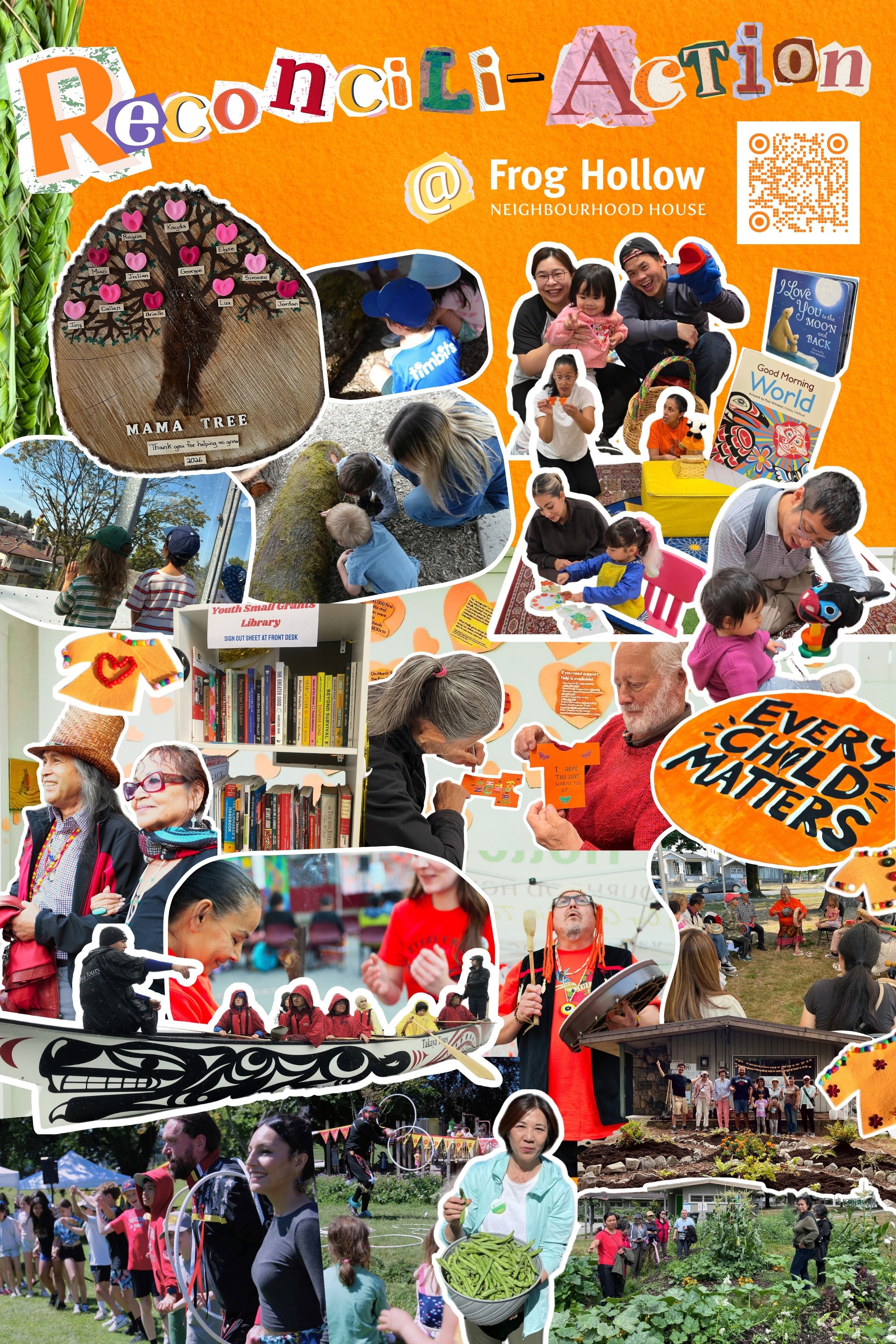

Across different areas of our work, staff and programs are finding their own ways to create opportunities for learning, reflection, relationship-building, and connection with Indigenous peoples, histories, cultures, and the lands where we live and work.
The stories below represent just some examples from several Frog Hollow programs, including our work with newcomers, families, seniors, employment participants, and community members. They do not capture everything happening across the House, but offer a glimpse into how this learning is being brought into everyday practice.
We want to recognize the work that has already been done, learn from the experiences and knowledge of Indigenous peoples and communities, and reflect on the work that we must continue together.
Through our programs and community activities, we hope to create opportunities for community members to learn, ask questions, listen, and participate in building a more respectful and inclusive community.
Decolonization is an ongoing journey. It is work that requires reflection, learning, relationship-building, and collective action. At Frog Hollow, we invite everyone to be part of this continued learning and to consider how, together, we can contribute to this important work.
Beginning with a Land Acknowledgement — WOW Program
In our WOW program, Wanda, our ELS teacher, begins the first session with a land acknowledgement and takes a moment to explain to participants why she does it.
Rather than treating the acknowledgement as simply a statement at the beginning of a cohort, she uses it as an opportunity to help participants understand the history and ongoing relationship Indigenous peoples have with the land where we live and work.
For newcomers, this creates space for learning, reflection, and respect, while recognizing that we are living and building community on Indigenous lands.
This is one small but meaningful way we can make decolonization visible in our everyday work and invite newcomer families to be part of this learning journey.
Creating Opportunities for Newcomers to Learn
During the COVID-19 period beginning in 2020, our organization continued supporting newcomers and families despite the ongoing impacts of the pandemic, focusing on employment, social services, and community integration.
One priority was to bring Indigenous topics into our programs by inviting clients to discuss Indigenous perspectives and explore their role in reconciliation and decolonization.
We also offered group programming at Clinton Park Fieldhouse and the Medicine Wheel Garden, where participants could learn from and connect with Indigenous traditional knowledge and perspectives.
At the same time, we strengthened employment programs by helping newcomers develop essential skills, understand the Canadian labour market, and gain practical work experience. Programs were diversified to meet the needs of youth, newcomers, and other community members, while family and employment programs were integrated to create stronger community connections.
Learning Through Conversation, Story and Art
Through the English Conversation Circle, Maysa has created opportunities for newcomers to learn about Indigenous histories and cultures in an accessible and engaging way.
She has invited a Chief from the Squamish Nation to share history and culture with participants and has also worked with an Indigenous artist on a root mapping project.
These activities were very engaging for participants, giving them the opportunity to learn about decolonization and demonstrating the importance of bringing these topics to newcomers regardless of their level of English.
The conversations generate curiosity and help extend the learning and message to more people.
Building Newcomer–Indigenous Connections
Frog Hollow has also offered culturally grounded programs such as Newcomer-Indigenous Connection and Restorative Circles, supported by Ana Lorena, Kwiiahwas Rochelle and Eva, as well as youth sessions in partnership with MOSAIC.
These programs help clients build meaningful connections, deepen cultural understanding, and strengthen relationships with Indigenous communities.
Shifts in comfort, trust, and cross-cultural engagement are indicators of progress. Through program records, observations and evaluations, staff can reflect on participants’ social networks, sense of belonging, and strengthening connections to their communities.
An Eight-Session Learning Journey
In 2022, we offered an eight-session program focused on Indigenous knowledge and decolonization.
The program gave participants the opportunity to learn directly from invited speakers and take part in deeper conversations about Indigenous history, knowledge, reconciliation and decolonization. Speakers included Frog Hollow Executive Director Norm Leech, among others.
The program provided dedicated space for participants to ask questions, listen and continue developing their understanding over a longer period of time.
Recognizing the Land in Employment Programs
Erika, our Employment Specialist at Sunrise Welcome Place, also brings these conversations into her work when beginning a new program.
She takes the opportunity to speak about the importance of recognizing that we live on Indigenous land and that Indigenous histories, cultures and communities continue to be present today.
She encourages participants to understand the meaning and origin of the land acknowledgement, learn more about the history of the land, and reflect on what it means to live on land that has been taken from First Nations.
For Erika, this recognition is also about cultivating gratitude and responsibility. She encourages participants to care for the land we live on, respect Indigenous peoples and their communities, and remain curious and open to learning.
When visiting new places, she invites people to notice Indigenous names, signs, dedications and other reminders of the people and stories connected to that land.
Her message is meaningful: recognizing Indigenous presence is about understanding the past, but it is also about how we choose to respect people and nature, care for the land, and learn from the places we visit every day.
Bringing Indigenous Learning into Everyday Family Programs
Our Family Programs also look for ways to weave Indigenous learning into everyday activities, stories, celebrations, and conversations with children and caregivers.
As families prepared to celebrate the Moon Festival, staff invited participants to talk about the shapes they could see when looking at the moon. Many participants shared that they could see the shape of a bunny. Staff then introduced families to the idea that Coast Salish stories and perspectives may see the raven represented in the moon, creating an opportunity to notice that different cultures understand and tell stories about the natural world in different ways.
Storytelling is another important part of this learning. After reading Good Morning World and learning the sign for “good morning,” families later explored stories connected to the moon and learned the sign for “good night.” Through books, conversation, movement and play, children are encouraged to experience different ways of understanding and relating to the world around them.
In La Colmena, families have also taken part in activities such as garland-making and circle time connected to Orange Shirt Day. Staff used puppets to introduce the upcoming Orange Shirt Day event and encouraged families to wear orange shirts and take part in the gathering.
These small moments allow children and caregivers to encounter ideas about Indigenous peoples, land, culture and reconciliation as part of their everyday learning rather than only on commemorative days.
Learning and Reflection with Seniors
Our Seniors Programs, including TAPS, have also created opportunities for participants to learn about residential schools, Indigenous cultures, and reconciliation.
Last year, seniors watched a video about residential schools and took part in a special origami activity to recognize Orange Shirt Day. Participants also created orange shirt crafts and an orange shirt garland as a way of acknowledging the day and reflecting together.
TAPS has also hosted drumming sessions, giving seniors an opportunity to gather, listen, participate and experience Indigenous cultural sharing in a community setting.
In November, seniors took part in a Cantonese-language workshop led by Professor Sung Ming Chow. During the workshop, Dr. Chow shared his insights into residential schools and discussed what this history means for settlers.
Offering this learning in Cantonese helped make these conversations more accessible to seniors who may otherwise face language barriers when learning about the history of residential schools, Truth and Reconciliation, and Indigenous-settler relationships in Canada.
Through these activities, seniors are given opportunities not only to learn about history, but also to reflect on their own relationships to this place and what reconciliation can mean in their everyday lives.
Beyond these program-based examples, Frog Hollow has also created community-wide opportunities for reflection, connection, and relationship-building.
Our Orange Shirt Day events honour the children and families harmed by residential schools while raising awareness of the ongoing impacts of colonization and the actions we can take toward decolonization.
Through National Indigenous Peoples Day, we celebrate the diverse Indigenous cultures of Turtle Island.
Land-based initiatives such as our Food Forest and Medicine Wheel Garden strengthen connections to the land, support food security, and create spaces for remembrance, including orange flowers planted to honour children who were forced to attend residential schools.
We have also hosted drum circles with newcomers to introduce Indigenous culture and teachings, deepen understanding of Canadian history, and encourage reflection on the role of settlers.
Experiences such as Takaya Tours canoe trips connect community members with the land and waters, highlight places of traditional significance to the Host Nations, and strengthen relationships across generations and cultures.